
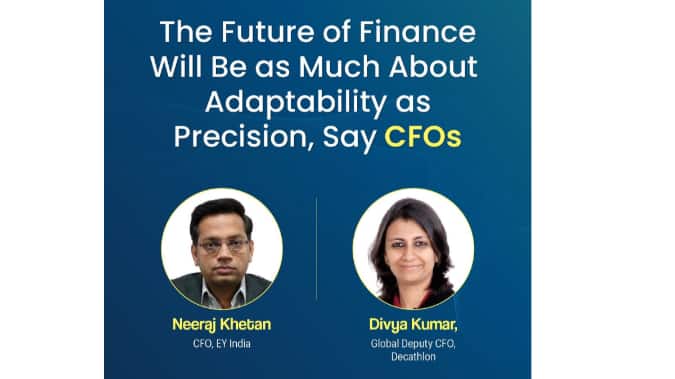
Artificial intelligence (AI) is reshaping the corporate landscape faster than ever and the role of the CFO is undergoing one of its most profound transformations in decades. They are rapidly evolving into strategic architects of the future — balancing technology, risk and growth in real time.
For Divya Kumar, Global Deputy CFO at Decathlon, the shift is already evident. “In addition to other roles, CFOs are now becoming ‘Chief Future Officers’. They need to stay ahead of disruption in the AI era, protecting market share while also shaping new cost and margin curves.”
“AI is also rewriting the risk playbook. Understanding and governing new AI risks, as well as staying on top of the changing regulatory environment, has become central to the CFO’s role,” she adds.
Similar views were echoed by Neeraj Khetan, CFO at EY (Ernst & Young) India. Tech infusion and automation, he says, have moved to the top of the agenda because finance now needs faster closes, cleaner datasets and more self-service reporting.
“Building a high-performing team is more important than ever since the finance function must combine business judgment with digital and analytical skills. Another priority is decision quality and speed because AI is raising expectations for real-time insights rather than backward-looking reporting.”
As per Kumar, AI is transforming financial planning on two fronts: first, improving planning and decision-making; second, changing the needs.
“AI has been embedded in areas of planning for years, especially in areas such as supply chain. What has changed now is the shift from siloed planning to synchronized planning across the enterprise at speed, for example, end-to-end planning from demand sensing to financial forecasting and connecting functions to make decisions faster around a unified objective.”
A bigger shift is also seen in the role of financial planning and analysis. In the current environment, flexibility in budgets, scenario planning and speedy insights have become critical to respond faster to the market.
Khetan says AI is reducing time spent on repetitive tasks and increasing the need for finance professionals who can interpret data, challenge assumptions and influence business decisions.
“The team structure is shifting toward a mix of finance, analytics, automation and business partnering roles. We are investing in data literacy, AI fluency, process automation and strategic thinking along with stronger communication and stakeholder management.”
Kumar refers to three big shifts. “First, AI literacy is becoming non-negotiable. Finance teams are working closely alongside data scientists, creating an exchange of skills. Second, there is a shift from task expertise to capabilities, for example, scenario planning, judgement in ambiguity and audit skills to govern AI outputs. Third, planning for structural shifts and process redesign as AI agents enter the workspace.”
Automation without accountability is a risk multiplier. Over-reliance on data and lower dependence on human judgement, especially when context is not explicitly captured in models, can cause wrong decisions. Therefore, it has become essential to create a culture that leverages automation boldly but with judgement as the control.
Today the most measurable value from AI in the finance function, as Khetan says, comes from three tightly connected areas: automation of transaction-heavy processes, forecasting/ FP&A, and controls/ fraud compliance.
“Automated reconciliations and journal entries (continuous accounting) cut time to nearly 20–40 per cent and reduce manual review hours by 30–50 per cent. Then, there is invoice processing and expense management, where intelligent OCR plus NLP auto-codes 70–90 per cent of invoices, slashing cycle time and exception handling FTE."
For Divya Kumar, Global Deputy CFO at Decathlon, the shift is already evident. “In addition to other roles, CFOs are now becoming ‘Chief Future Officers’. They need to stay ahead of disruption in the AI era, protecting market share while also shaping new cost and margin curves.”
“AI is also rewriting the risk playbook. Understanding and governing new AI risks, as well as staying on top of the changing regulatory environment, has become central to the CFO’s role,” she adds.
Similar views were echoed by Neeraj Khetan, CFO at EY (Ernst & Young) India. Tech infusion and automation, he says, have moved to the top of the agenda because finance now needs faster closes, cleaner datasets and more self-service reporting.
“Building a high-performing team is more important than ever since the finance function must combine business judgment with digital and analytical skills. Another priority is decision quality and speed because AI is raising expectations for real-time insights rather than backward-looking reporting.”
As per Kumar, AI is transforming financial planning on two fronts: first, improving planning and decision-making; second, changing the needs.
“AI has been embedded in areas of planning for years, especially in areas such as supply chain. What has changed now is the shift from siloed planning to synchronized planning across the enterprise at speed, for example, end-to-end planning from demand sensing to financial forecasting and connecting functions to make decisions faster around a unified objective.”
A bigger shift is also seen in the role of financial planning and analysis. In the current environment, flexibility in budgets, scenario planning and speedy insights have become critical to respond faster to the market.
Khetan says AI is reducing time spent on repetitive tasks and increasing the need for finance professionals who can interpret data, challenge assumptions and influence business decisions.
“The team structure is shifting toward a mix of finance, analytics, automation and business partnering roles. We are investing in data literacy, AI fluency, process automation and strategic thinking along with stronger communication and stakeholder management.”
Kumar refers to three big shifts. “First, AI literacy is becoming non-negotiable. Finance teams are working closely alongside data scientists, creating an exchange of skills. Second, there is a shift from task expertise to capabilities, for example, scenario planning, judgement in ambiguity and audit skills to govern AI outputs. Third, planning for structural shifts and process redesign as AI agents enter the workspace.”
Automation without accountability is a risk multiplier. Over-reliance on data and lower dependence on human judgement, especially when context is not explicitly captured in models, can cause wrong decisions. Therefore, it has become essential to create a culture that leverages automation boldly but with judgement as the control.
Today the most measurable value from AI in the finance function, as Khetan says, comes from three tightly connected areas: automation of transaction-heavy processes, forecasting/ FP&A, and controls/ fraud compliance.
“Automated reconciliations and journal entries (continuous accounting) cut time to nearly 20–40 per cent and reduce manual review hours by 30–50 per cent. Then, there is invoice processing and expense management, where intelligent OCR plus NLP auto-codes 70–90 per cent of invoices, slashing cycle time and exception handling FTE."
As per him, the second most quantifiable impact is seen in FP&A, forecasting and pricing. "Demand and revenue forecasting with ML-based models improves forecast accuracy by 10–25 per cent and reduces planning cycle time, directly feeding into better working capital and margin management."
The third benefit, he says, can be witnessed around fraud mitigation and compliance management. "Real-time fraud and anomaly detection cut fraud losses by 15–20 per cent, reducing the number of analysts needed for manual review. OCR-led contract readers help in better compliance with GST and other laws.”
According to him, technical competence will be assumed in the next 3–5 years. "As AI increasingly takes over the mechanics of finance — fast closes, predictive forecasting and automated controls — the real differentiator will be the human and strategic dimensions of the role, that is, decision quality under ambiguity, not computational sophistication," Khetan says, adding, “No algorithm can replicate that human layer: context, ethics, accountability and judgment".
Kumar notes that finance teams will see the strongest AI success in areas where outcomes are clearly defined, such as reducing time to close and improving forecast accuracy.
Success in finance, she says, will depend on mindset, judgement and agility in the coming years. It starts with finance teams changing their mindset to become comfortable operating amid ambiguity and dynamic, scenario-based outcomes. “It is also about combining automation heft with human intuition.”
Kumar concludes, “Agility in processes and people will be critical to adapt quickly as business evolves. The future of finance will be as much about adaptability as precision.”