
There doesn't seem to be any end to the US-Iran war soon. One night, the headlines speak of ceasefires. The next morning, they carry images of fresh bombardments. This has hit economies across the globe badly and there are multiple repercussions. A war-driven crisis creates fear, uncertainty, confusion and indecisiveness due to lack of information and rapidly changing situations. Such a situation calls for leadership to stay calm while enabling the organization to make informed, timely decisions.
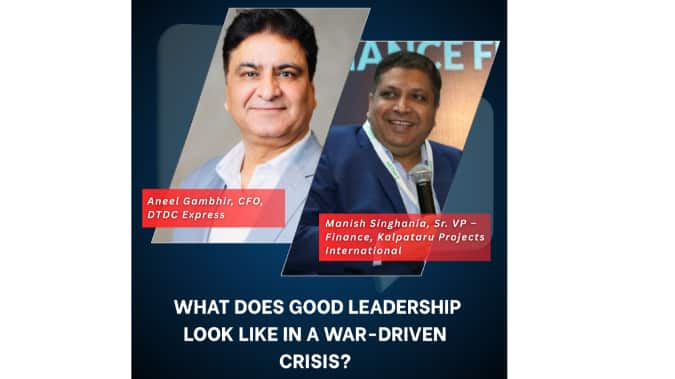
Aneel Gambhir, CFO, DTDC Express, doesn’t describe leadership in grand, heroic strokes. He speaks of it like a discipline that is quiet, deliberate and almost invisible when done right.
“Good leadership for a CFO in such times is anchored in clarity, agility and resilience. It involves staying calm amidst uncertainty while enabling the organization to make informed, timely decisions. A CFO must ensure liquidity, maintain financial discipline and provide forward-looking insights despite limited visibility."
Equally important, he stresses, is transparent communication with stakeholders to sustain trust and reinforce confidence. "In a war-driven crisis, leadership also means balancing short-term survival with long-term sustainability, without losing sight of the organisation’s core purpose.”
When Systems Fail, People Lead
Manish Singhania, Sr. VP – Finance, Kalpataru Projects International, sees the same moment through a different lens. He talks of people, instead of systems.
“War driven crisis creates fear, uncertainty, confusion and indecisiveness due to lack of information and rapidly changing situation. In normalised operation, CFO is expected to be system driven and demanding. In the moments of crisis, empathic style and showcasing confidence to handle testing times boost team morale and ensure intent to business as usual.”
The Expanding Role: From Steward to Sentinel
CFOs have always been the financial stewards of their organisations — and this role hasn't changed. In fact, it has expanded.
“The current environment demands a far more proactive and integrated risk management approach. The CFO is now deeply involved in scenario planning, stress testing business models and evaluating geopolitical, supply chain and currency risks in real time," says Gambhir.
There is a heightened focus on capital allocation decisions, ensuring that every investment aligns with resilience and optionality. "In many ways, the CFO is acting as a strategic co-pilot to the CEO, helping navigate uncertainty with data-driven insights and risk-informed decision-making,” he adds.
Singhania is more direct, almost blunt about the shift. He says, “In circumstances where uncertainty becomes rule and situation changes dynamically, focus has shifted to ensure business continuity as well keeping tab on increased cost. Finance need to balance both.”
The Risks That Don’t Sleep
Gambhir speaks of three risks he tracks daily since the conflict escalated. These risks are interconnected. None of them are static.
“First is, liquidity and cash flow stability: Ensuring sufficient buffers to withstand demand shocks, delayed receivables or disruptions in funding markets.
Second is, supply chain and operational continuity: Monitoring disruptions across routes, vendors and geographies; and building redundancies where possible.
Third is, currency volatility and cost inflation: Managing exposure to fluctuating exchange rates, fuel prices and input costs, which can significantly impact margins.”
Singhania says, “I represent EPC (Engineering, Procurement and Construction) company and contracts are long term with predetermined rates. Since ours is labour-intensive sector, LPG crisis has hit us immediately and deeply as non-supply of LPG resulted in non-functioning of canteen and mess. Further, sharp price increase in petrochemical products and its non-availability is major issue. From longer period perspective, looming economic slowdown and its impact on real estate is the biggest risk.”
Planning for the Unknown
If leadership is about answers, war strips that comfort away.
Singhania puts it plainly: “As war started on the verge of financial year closure and next year business planning, it has created lot of uncertainty. Since, there is no clarity, we have prepared two scenario planning in the business plan and have proposed to revisit business plan after Q1 where more clarity is expected.”
The Shape of Leadership Now
So, what does good leadership look like in a war-driven crisis?
It looks like:
· A CFO who speaks calmly when the data is incomplete.
· A leader who chooses transparency over reassurance theatre.
· A strategist who prepares for disruption without becoming paralysed by it.
· A manager who knows when to switch from systems to empathy.
· A decision-maker who protects cash today without compromising tomorrow.
Most of all, in such uncertain times, leadership is not about being right. It’s about being ready.