
The global narrative is fractured. Donald Trump signals a possible five-day ceasefire and hints at negotiations, while Iran rejects the claim outright, calling it “fake news.” At the same time, Israel has intensified strikes, reinforcing a sense that the situation is far from de-escalation.
For corporate India, the noise of geopolitics is translating into something far more alarming —cost spikes, supply disruptions, currency pressure and a growing sense that volatility is no longer episodic, but structural. Inside boardrooms, CFOs are not reacting to headlines; they are recalibrating entire playbooks.
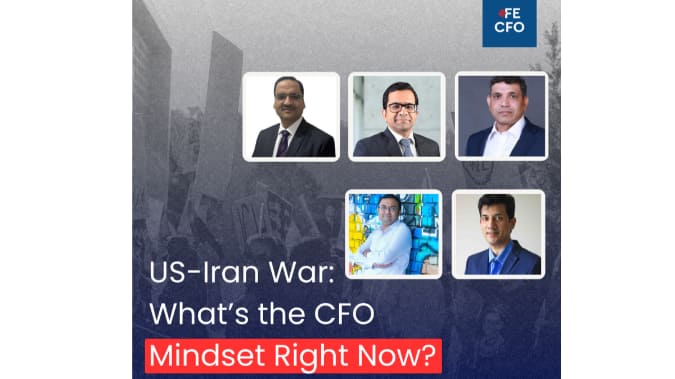
Amit Agarwal, Executive Director & Group CFO, DCM Shriram Ltd. frames the moment in stark operational terms.
“Prices of inputs as well as outputs are going up. Maximise the returns on current inventory,” he says, before laying out a series of actions that reflect both urgency and discipline. “Pass on the increased costs to customers and use force majeure, where possible. Secure supply chains and optimise production to the extent possible.”
But the most telling part of his thinking lies in contingency planning. “Have enough financial liquidity assuming no production for two months. Tie-up more long-term funds. Maintain a 60:40 ratio. Stay hedged on currency. No derivative structures for now. Keep track of risks and see how it will impact the organisation.”
That sense of escalation is echoed by Deepak Raj Jain, CFO, Jaquar & Company, who connects the dots between geopolitics and macroeconomic stress.
“The present war situation has already started impacting businesses in many ways . The EPC companies, whose order book consists of projects in the Middle East, are seeing their overall imports and exports getting impacted due to supply chain disruption and energy security concerns, creating trade imbalance,” he says.
“With crude price increases, the US dollar is getting stronger against the Indian Rupee, which is tending to inflation and finally having an impact on corporate earnings. ,This is already evident via stock markets. If the situation persists, it will impact employment in the long term, leading to a cascading impact on the economy,” Deepak says.
Ashish Tiwari, Group CFO, TCI (Transport Corporation of India) Group articulates the philosophical shift underway in finance functions.
“Amid the US–Iran conflict, the CFO mindset is calmly defensive yet selectively offensive,” he says, choosing his words carefully. “The focus is on safeguarding liquidity, stress-testing supply chains and energy exposure, and locking in key input costs where possible, while still funding high-conviction growth and technology investments.”
The balancing act is deliberate. “For import-heavy balance sheets, rapid recalibration of hedging and counterparty limits is critical in the face of a stronger US dollar and heightened volatility.”
“Ultimately, it’s about disciplined scenario planning, transparent stakeholder communication and using volatility to build long-term resilience rather than reacting to daily headlines,” Tiwari adds.
It’s a subtle but important shift — from reacting to events to engineering resilience through them.
In logistics, where disruption hits first and hardest, Santosh Abbimane, CFO, Xpressbees is even more direct.
“Volatility is back on the table. Our job is to stay ahead of it, not react to it. The key point is to plan for uncertainty, not wait for clarity,” he says, setting the tone for what follows.
He breaks down the challenge into operational realities. “In logistics, our immediate focus is on staying agile — protecting margins without disrupting service levels.”
Then comes a granular view of the pressure points. “Demand Sensitivity: watching the consumer pulse closely. Fuel Volatility: from cost line to strategic lever.” In logistics, fuel is not just a cost — it’s a risk variable we need to actively manage.
For logistics players, the biggest near-term variable is fuel inflation, which directly impacts linehaul and last-mile costs. Most companies are actively recalibrating through fuel surcharges, tighter route optimization and dynamic pricing, while being mindful of demand elasticity among e-commerce and D2C clients.
He continues, highlighting the interconnected nature of demand and cost pressures. “We are watching consumption indicators very closely. Any sustained pressure on fuel prices tends to reflect quickly in discretionary demand, which is critical for e-commerce volumes.”
“At the same time, I believe, CFOs are preparing for second-order effects, that is, inventory corrections by clients, changes in shipping cycles and potential softening in certain categories.”
The human element, often overlooked, is equally critical. He talks of labour stability — managing the human backbone, which gets impacted because of commercial fuel and domestic gas shortages.
In an environment like this, cash discipline becomes non-negotiable. The focus is on liquidity buffers, tight working capital, and prioritised capex.
In contrast to logistics, the consumer tech and food space faces a different kind of uncertainty — demand volatility layered over cost pressures. Piyush Kakkad, CFO, Rebel Foods, draws a sharp comparison with the recent past.
“Covid taught us business can go through significant unplanned disruptions and we need to be mentally prepared to navigate through these, as and when such situations arise. “Also, in these times, capital preservation and out-of-box thinking becomes utmost important as one cannot gauge timelines for situations to normalise.”
Differentiating between this crisis and Covid, Kakkad says, “Covid became a way of life and uncertainty at that time was when the situation would normalise. Also, it was caused by a pandemic hence the world was together to solve this. Today's situation is created through war where the world order is getting revisited.”
“One is uncertain when the situation would normalise or whether it would further get aggravated because of the war, ” he adds.
Across sectors, the language varies but the underlying message is consistent. Liquidity is being guarded, risks are being mapped in real time and strategies are being stress-tested against scenarios that would have seemed extreme not long ago.
The ceasefire may or may not happen. Diplomatic signals may shift by the day.
For CFOs, however, the working assumption is clear: uncertainty is here to stay, and resilience is now the core metric that matters.